




From idealism to tyranny: Plato, Orwell, and the political reality of Pakistan
Urwa Afzal
|
26 Dec 2025
Throughout history, philosophers and writers have warned of how noble ideals in politics can devolve into oppression when power goes unchecked.
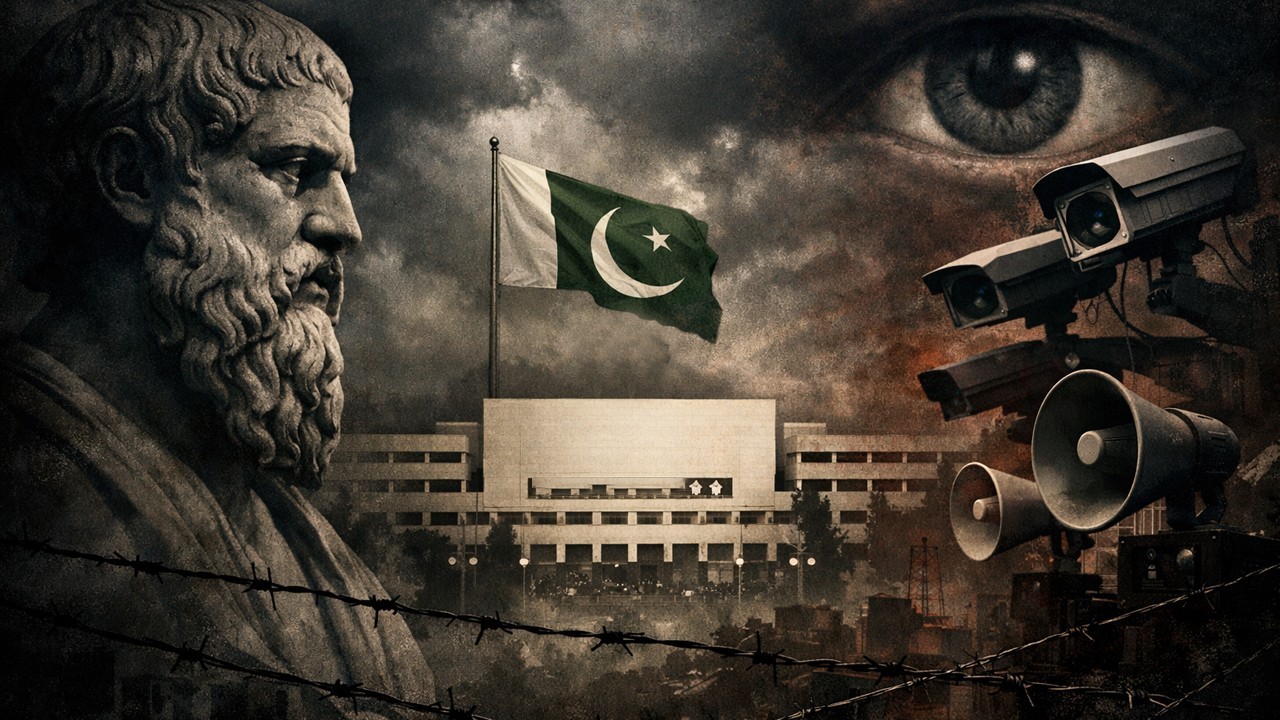
The most powerful explorations of this theme are Plato’s The Republic and George Orwell’s Animal Farm. Though separated by over two millennia, these works speak to the same truth: the decline of justice and reason in governance leads societies toward tyranny. This theoretical cycle outlined by Plato and illustrated allegorically by Orwell reflects the political evolution of modern Pakistan.
Plato’s The Republic lays out a political hierarchy beginning with aristocracy, his ideal form of government. In this system, power is conferred in philosopher kings. These kings are wise, just, and rational leaders who rule not for personal gain, but for the good of the whole society. This government values harmony, education, and justice. At the time of Pakistan’s independence in 1947, the vision of an equitable and just state, promoted by Muhammad Ali Jinnah, mirrored this Platonic ideal. Though Pakistan was not governed by philosopher kings, Jinnah’s emphasis on unity, faith, and discipline reflected a leadership striving for justice, inclusion, and constitutional order. However, as Plato predicted, ideal states are fragile and can quickly deteriorate.
According to Plato, aristocracy gives way to timocracy—a government based on honor and militarism. In Pakistan’s context, the shift from idealism to militarism was obvious with the country’s first military coup in 1958 under General Ayub Khan, when the prime minister was Feroz Khan Noor. This marked the beginning of a new political order dominated by the military, where authority was justified by discipline, control, and nationalism. Subsequent regimes, particularly under General Zia-ul-Haq and General Pervez Musharraf, aligning closely with Plato’s description of a timocracy. The government’s priorities shifted from public welfare to national defense, ideological enforcement, and internal stability.
From timocracy, Plato argues, a state degenerates into oligarchy, where the wealthy and elite rule in their own Interest. In Animal Farm, Orwell presents this shift when the pigs—initially comrades in a socialist revolution—begin enjoying luxuries, and changing laws to serve themselves. Likewise, in Pakistan, political and economic power has largely become concentrated in the hands of influential families, the establishment, and business tycoons. The increasing trend of privatization, in this context, often means transferring public assets into the hands of this elite class. Instead of increasing efficiency and public welfare, privatization in Pakistan is frequently criticized for serving elite economic interests, leading to inflated prices, reduced access to services, and loss of public accountability. Public institutions, who are intended to serve the people, are under the control of elites and they are enjoying the luxurious lifestyle while the common citizen struggles with inflation, unemployment, and underfunded services. Orwell’s Animal Farm mirrors this transformation clearly; the pigs, who initially promise equality, end up controlling all resources, changing laws for their benefit, and living in luxury while others suffer. The original slogan
“All animals are equal” becomes a cruel mockery: “All animals are equal, but some animals are more equal than others.”
Following oligarchy, Plato’s theory suggests that a state devolves into democracy, not in the idealized sense of people’s rule, but in a disorganized and chaotic form where excessive freedoms are exploited. In this stage, everyone pursues personal desires without restraint. In Pakistan, electoral democracy exists but is frequently undermined by manipulation, horse-trading, disqualification of political leaders, and interference by unelected institutions. Just as in Animal Farm, where animals are told they have rights while being systematically deprived of them, Pakistani citizens are promised representation, yet many feel excluded from real decision making. The democratic process is often used as a cover for undemocratic practices.
This fragile democracy collapses into tyranny .Plato describes the tyrant as a ruler who gains power through false promises and rules through fear and violence. Orwell illustrates this in Napoleon, who silences dissent, erases history, and rules through fear and violence. In Pakistan, many observers note disturbing signs of this final phase which includes growing authoritarianism, shrinking space for free speech, censorship of journalists, suppression of political opposition, and the weakening of judicial independence. Laws are changed to serve those in power, dissent is criminalized, and citizens face increasing difficulty in holding leaders accountable. The recent targeting of political activists, media blackouts, and manipulation of digital spaces reflect the traits of tyranny described by Plato and dramatized by Orwell.
Moreover, authoritarianism is often cloaked in populist rhetoric. Just as Orwell’s pigs claimed to act “for the good of all animals,” Pakistani rulers justify harsh actions by invoking national interest, religious sentiment, or national security. Yet these narratives conceal the erosion of public rights and the centralization of unchecked power. Plato’s tyrant manipulates emotion and fear to dominate, while Orwell’s Napoleon uses propaganda (Squealer) and violence (the dogs) to crush opposition. In today’s Pakistan, propaganda flows through media regulation and orchestrated disinformation, while the mechanisms of fear are enforced through legal harassment and security crackdowns.
In conclusion, The Republic and Animal Farm are not distant philosophical or literary texts; they are deeply relevant lenses through which we can view Pakistan’s political reality. Both Plato and Orwell warn that without vigilance, justice, and wisdom, societies fall into cycles of decay, no matter how noble their founding ideals. Pakistan’s journey from post-colonial hope to democratic struggle, establishment's dominance, elite capture, and creeping authoritarianism is not unique, but it is urgent.
To escape the fate of Plato’s tyrannical state or Orwell’s corrupted animal farm, Pakistan must restore its commitment to justice, transparency, civic education, and inclusive governance. As history, philosophy, and fiction all remind us: unchecked power always ends the same way.









Comments
0 comment