




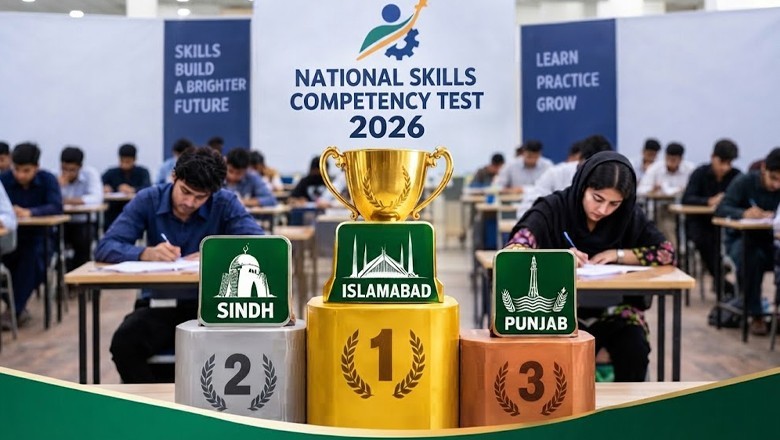
Islamabad tops, Sindh beats Punjab in National Skills Competency Test 2026
Web Desk
|
10 Sep 2026
The Higher Education Commission (HEC) has released detailed results of the National Skill Competency Test (NSCT) 2026. Results showed major differences in the performance of computing students across Pakistan's provinces.
According to the HEC's official NSCT report, 33,038 candidates successfully appeared in the assessment, which was designed to benchmark the skills of students in computing programmes against the requirements of Pakistan's rapidly evolving technology sector. The assessment was conducted across 165 centres in 112 cities and represented a major expansion in participation compared with the previous edition. H Higher Education Commission of Pakistan+1
The provincial data contained in the HEC analysis shows Islamabad Capital Territory (ICT) emerging as the best-performing region, with 52.9 per cent of candidates achieving the passing threshold of 50 marks or above.
At the opposite end of the spectrum, Balochistan recorded the lowest pass rate at 29.0 per cent, meaning that 71.0 per cent of candidates from the province scored below the passing threshold.
The results highlight a substantial geographic variation in the performance of Pakistan's emerging IT talent.
Islamabad tops provincial rankings
The HEC data shows that Islamabad was the only region in which more than half of the candidates passed the assessment.
The difference between Islamabad and Balochistan stands at 23.9 percentage points, underlining the scale of the regional disparity captured by the assessment.
Sindh surpasses Punjab
While Islamabad achieved the highest success rate, Punjab emerged as the largest source of candidates, with 20,217 students taking part in the assessment.
Despite accounting for the overwhelming majority of candidates among the regions highlighted in the analysis, Punjab's pass rate stood at 39.4 per cent, with 60.6 per cent failing to reach the 50-mark benchmark.
Sindh performed somewhat better, recording a 42.0 per cent pass rate, while the failure rate stood at 58.0 per cent.
The results therefore present an interesting contrast between candidate volume and candidate performance: Punjab supplies the largest talent pool, but Islamabad records the strongest proportion of successful candidates.
Balochistan records highest failure rate
Balochistan registered the most difficult outcome in the provincial comparison.
Only 29.0 per cent of candidates from the province passed, while 71.0 per cent failed to reach the required score.
Khyber Pakhtunkhwa followed with a 30.2 per cent pass rate and 69.8 per cent failure rate. AJK recorded a 31.0 per cent pass rate, while Gilgit-Baltistan and overseas candidates each recorded 32.6 per cent.
The concentration of lower pass rates among several geographically remote or underserved regions raises questions about disparities in access to quality computing education, teaching resources, laboratories, internet connectivity and industry exposure.
However, the HEC figures are assessment results rather than evidence that geography itself causes lower academic performance. Differences may reflect a combination of educational, institutional, socioeconomic and infrastructure-related factors.
Gender performance gap remains limited
The HEC's gender analysis produces a notably different picture.
The assessment included 11,990 female candidates, compared with 21,047 male candidates. Male participation was therefore substantially higher, approaching a two-to-one ratio.
Despite this major difference in participation, the performance gap between the two groups was relatively small.
Female candidates recorded a 37.0 per cent pass rate, while male candidates recorded a 39.5 per cent pass rate.
The difference is therefore only 2.5 percentage points.
The figures suggest that the more prominent gender challenge identified by the assessment is participation rather than a large difference in success rates.
In practical terms, considerably fewer women participated in the assessment, but those who did participate performed relatively close to their male counterparts.










Comments
0 comment